Roof repair is the right call far more often than people expect. A shingle roof rarely fails all at once. It fails at a few weak points: a tab the wind folded back, a rubber collar that cracked around a vent pipe, a strip of flashing that pulled loose at the chimney. Fix those points properly and the rest of the roof can keep doing its job for years. Bulldog Roofing Upstate repairs shingle roofs for homeowners across Anderson, Pickens, Oconee and Greenville counties.
Every repair starts with a free inspection. We get up on the roof and look at the problem you called about, then at the rest of the slope around it, because one failed spot is often a sign of what is coming next. You hear what we found and what we would do about it before anyone talks price.
Upstate SC gives a roof plenty to deal with. Spring and summer thunderstorms bring wind and the odd round of hail, wooded lots drop limbs and leaves, humid summers bake the shingles, and the occasional winter ice storm adds weight at the edges. Small damage from any of those is what a repair is for.
Common Roof Repairs on Shingle Roofs
These are the parts of a shingle roof that most often need repair. Each one has its own way of failing.
Lifted, creased or missing shingles
Asphalt shingles are held down by nails and by a strip of sealant that bonds each course to the one below it once the sun warms it. When a strong gust gets under a tab, it can break that bond and fold the shingle back. Sometimes the tab tears off and blows into the yard. Other times it lies back down with a crease across it, which looks fine from the ground but has cracked the mat and will let water in. A repair means lifting the courses around the damage, pulling the old nails, sliding in a new shingle and nailing and sealing it so it sits flat with its neighbors.
Flashing at chimneys and walls
Flashing is the metal that seals the joint where the roof meets something that sticks up through it or runs alongside it: a chimney, a dormer wall, a second-story wall. Step flashing is woven in with the shingles one piece per course, and counterflashing covers it from above. Over time sealant dries out, mortar joints holding the counterflashing crumble, and nails back out. Repairing flashing properly usually means removing the shingles along that joint and resetting or replacing the metal, not adding another bead of caulk on top of the old one.
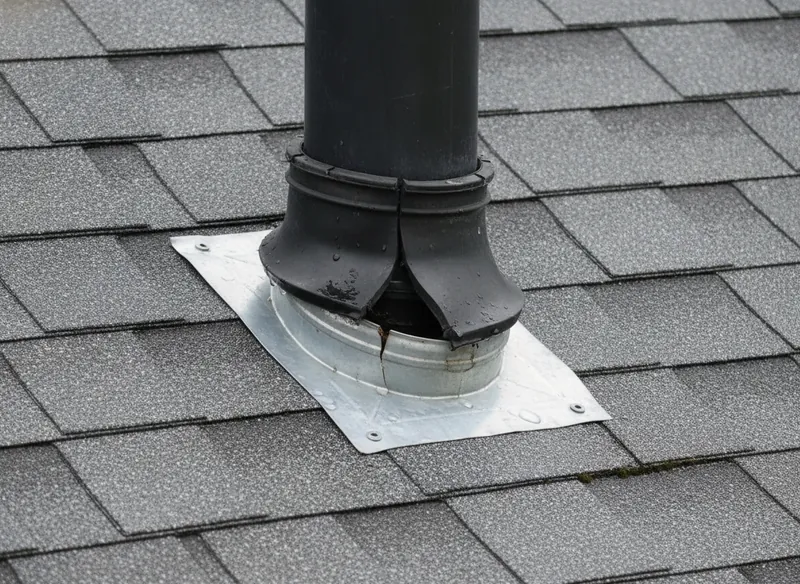
Cracked pipe boots
Every plumbing vent that comes through the roof wears a boot: a flat base that tucks under the shingles and a rubber collar that hugs the pipe. The rubber is the weak link. Long summers of sun dry it out until it splits, and once it splits, water runs straight down the pipe into the attic. Replacing a pipe boot is one of the smallest repairs on a roof.
Valleys where two slopes meet
A valley carries water from two roof planes at once, so it handles more runoff than any other part of the roof. Leaves and pine straw collect there and hold moisture, and the shingles in a valley tend to wear faster than the open field. Valley repairs range from replacing a few worn shingles to rebuilding a section with new underlayment and either woven or cut shingles, depending on how the valley was built in the first place.
Ridge caps and ridge vents
The ridge is the peak of the roof, capped with folded shingles that take wind from both sides. Ridge cap shingles crack, lift and lose their granules before the rest of the roof does. Where the house has a ridge vent, the vent itself can split or work loose, and a loose vent lets wind-driven rain into the attic. Repairs here mean new cap shingles, a new section of vent, or both.
Drip edge along the eaves and rakes
Drip edge is the bent metal strip along the edges of the roof. It supports the edge of the first course of shingles, steers water away from the fascia board, and closes the gap where small animals and insects like to get in. Missing or bent drip edge leads to rotted fascia and soft decking at the edge of the roof. Adding or replacing it is a repair that protects the wood behind it.
Small areas of soft decking
The decking is the plywood or OSB sheathing the shingles are nailed to. When water has been getting in at one spot for a while, the decking underneath can go soft, and a new shingle nailed into soft wood will not hold. Replacing a small section of decking, along with the underlayment and shingles over it, is still a repair. If the soft wood stretches across large parts of the roof, that is a different conversation.
How a Roof Repair Visit Goes
You call or send the form and we will call you back to set up the free inspection. Tell us what you have spotted: missing pieces in the yard, a stain inside, a spot that looks different from the ground. On the day, we start on the roof, at that spot and the area around it, including the flashing, vents and edges nearby, and we check inside and in the attic where there is a stain or access.
Before you decide anything, we walk you through what is damaged, what caused it if we can tell, and what the repair would involve. There is nothing to sign on inspection day. If water is already coming inside, our page on roof leak repair covers what to do indoors in the meantime and why tracing the leak back to its source matters.
We cover the whole area, from Anderson, Belton and Honea Path to Clemson, Seneca and Walhalla, and up through Powdersville, Easley and roof repair in Greenville. Wherever the house is, the inspection is free.
Repair or Replace? What Decides It
If a repair will do it, that is what we will tell you. The roof's age, the condition of the decking and how many separate problems there are decide it, not a sales target.
A repair makes sense when the damage is limited to one area and the shingles around it are still in good shape: flexible, holding their granules, lying flat. That covers a lot of roofs. Architectural shingles typically last somewhere around 20 to 30 years in a climate like ours, often less on a roof with poor attic ventilation or heavy shade, and a roof well inside that range is usually worth repairing.
Replacement starts to make more sense when the problems are spread across the roof instead of in one place. Brittle shingles that crack when they are lifted, bald patches where the granules have washed off, curling edges on several slopes, or soft decking in more than one spot all point that way. A roof near the end of its life can turn repairs into a money pit, where every storm finds a new weak spot. When that is where things stand, we will say so and explain what a full roof replacement would involve, so you can weigh the two side by side.
What You Get From Bulldog Roofing Upstate
- A free inspection before anything else. You know what is wrong with the roof, and what it would take to fix, before any price comes up.
- The repair fits the problem. A cracked pipe boot gets a new boot. A torn shingle gets a new shingle. The fix matches what actually failed.
- Straight talk on repair versus replacement. If the roof has plenty of life left, you hear that. If it is nearing the end, you hear that too, with the reasons.
- Shingle roofs across Upstate SC. Twelve towns in Anderson, Pickens, Oconee and Greenville counties, Monday to Friday, 8 AM to 7 PM. Call (864) 702-2478.